State of our Forests and Public Lands
From Washington Conservation Action
The 10th annual "State of Our Forests and Public Lands" is a 56-page report by Washington Conservation Action (WCA), evaluating the progress of the Washington Department of Natural Resources (DNR) and Commissioner of Public Lands (CPL) Dave Upthegrove during his first year in office (2024-2025). It highlights key achievements, challenges, and opportunities in managing Washington’s forests, aquatic lands, and rangelands.
Grades at a Glance
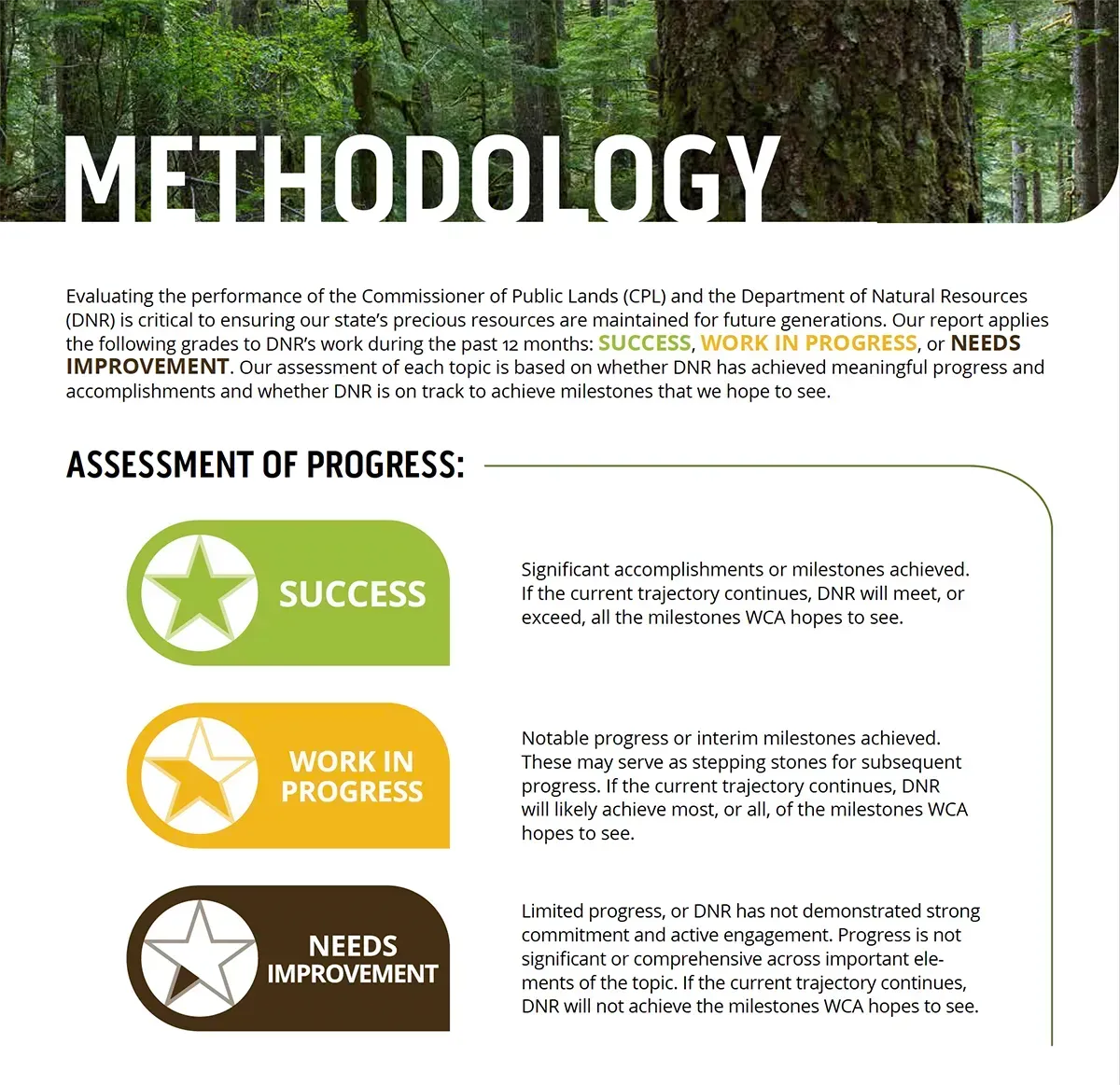
A two-page summary, beginning with
Methology and color-coded Assessment of Progress.
Green = SUCCESS,
Gold = WORK IN PROGRESS,
Brown = NEEDS IMPROVEMENT.
Key Highlights:
- Leadership Transition: Dave Upthegrove was elected CPL in 2024, promising conservation, environmental justice, and Tribal co-management. His administration has taken initial steps to modernize DNR’s approach to managing natural resources.
- Mature Forest Conservation: Upthegrove paused logging of mature forests and announced the conservation of 77,000 acres of older, structurally complex forests. However, implementation challenges and continued logging of some older forests remain concerns.
- Wildfire Resilience: DNR launched new programs like Community Wildfire Ambassadors and supported updates to wildfire protection plans. However, wildfire resilience funding was cut significantly, threatening progress.
- Beneficial Fire: DNR set a goal of 100,000 acres of prescribed fire annually but lacks a clear plan and sufficient funding to achieve this target.
- Forest Health: Progress has been made in treating 1.1 million acres under the 20-Year Forest Health Strategic Plan, but broadcast burning remains underutilized.
- Carbon Sequestration: DNR has not yet developed a statewide strategy to enhance carbon storage in forests, leaving a gap in Washington’s climate strategy.
- State Trust Lands: DNR has not fully integrated public benefits into state trust land management, despite legal obligations affirmed by the CNW v. Franz decision. Sustainable Harvest Calculations (SHC) are delayed, and the agency has yet to optimize for ecological and social values.
- Adaptive Management Program (AMP): Progress was made in securing funding and adopting the Type Np riparian buffer rule to protect stream temperatures. However, the water typing rule fell short of its objectives, and DNR’s leadership in addressing stakeholder trust is needed.
- Aquatic Lands: DNR made progress in removing pollution, protecting kelp and eelgrass, and restoring aquatic habitats. The upcoming Aquatic Strategic Plan is an opportunity to formalize these efforts.
- Clean Energy: No new clean energy leases were signed, but DNR is shifting toward more inclusive and environmentally reviewed development. Community Benefits Agreements and equity metrics are still lacking.
- Environmental Justice: The Office of Environmental Justice, Equity, and Civil Rights was elevated within DNR, but staffing and budget constraints have slowed progress. Embedding environmental justice across all divisions remains a priority.
- Tribal Relations: DNR has strengthened engagement with Tribes, including transferring forestland through the Trust Land Transfer program. However, more work is needed to expand Tribal co-management and leadership within the agency.
Legislative Outcomes:
Passed: Prescribed Fire Claims Fund (HB 1563) to support prescribed and cultural burns.
Funded: Carbon sequestration in mature forests ($23M), Adaptive Management Program ($2.8M), derelict structure removal ($2M), and Trust Land Transfer ($16.9M for Tribal land transfers).
Underfunded: Wildfire risk reduction funding fell short of the $125M biennial commitment, receiving only $60M.